
Warsan 4 has one structural weakness that investors consistently raise: no metro access. The community sits on E311, with bus connections to the Red Line, but direct rail connectivity has remained out of reach. That is changing — and the timeline is now confirmed.
The Dubai Metro Blue Line is under active construction, with three stations confirmed in International City, which shares its boundary with Warsan 4. The line is scheduled to open on 9 September 2029. Construction reached 12% completion by December 2025 and is on track for 30% completion by end of 2026, according to RTA Director General Mattar Al Tayer.
The RTA has officially stated that the Blue Line is anticipated to boost land and property values by up to 25% around its stations. That figure comes directly from the Roads and Transport Authority — not a market forecast, not a developer projection. It is the government's own assessment of the infrastructure's impact on surrounding real estate.
For Warsan 4 investors, this changes the calculation materially. The question is no longer whether metro connectivity is coming. It is how much of the appreciation window remains open before that connectivity is priced in.
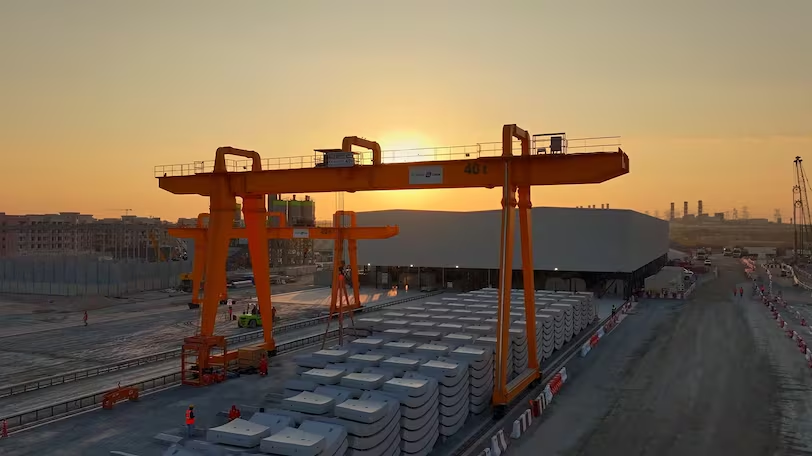
- Three Blue Line stations confirmed in International City — directly adjacent to Warsan 4 — with the main interchange station (IC1) being the largest underground station on the line
- Opening date: 9 September 2029. Construction is 12% complete as of December 2025, targeting 30% by end of 2026
- The RTA officially projects up to 25% increase in land and property values around Blue Line stations
- Historical precedent: properties near Red Line stations appreciated 26.7% between 2010 and 2022, outpacing the citywide average of 24.1% (CBRE data)
- Properties within a 10-minute walk of confirmed Blue Line stations in the Warsan corridor could command up to 15% premium in sale prices once services begin
- The Blue Line will provide direct connectivity to Dubai International Airport in 20 minutes from International City
- Warsan 4's Nakheel Green Wood TOD zone is explicitly designed around a future metro station — the infrastructure relationship is planned, not incidental
What the Blue Line is: confirmed facts
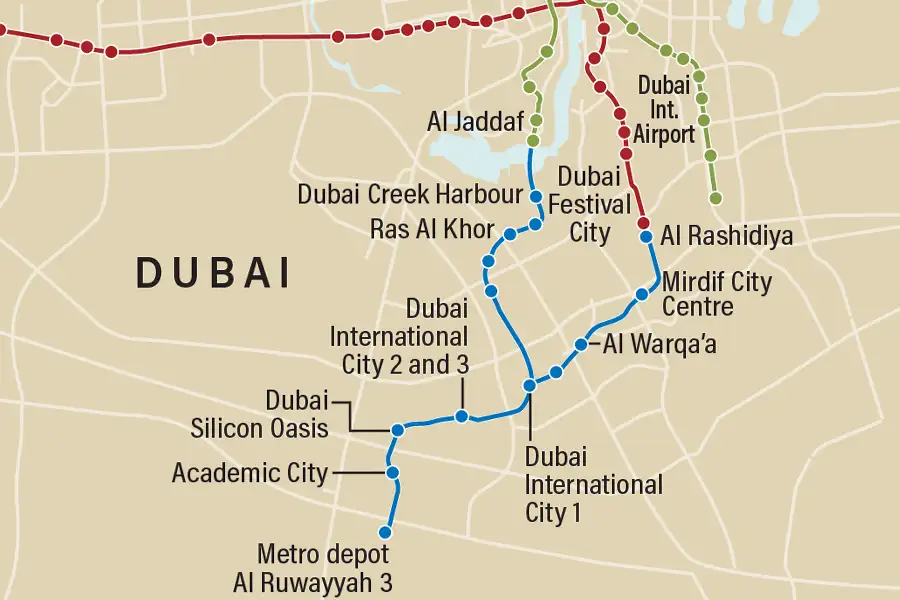
The Dubai Metro Blue Line is the third metro line in the city, after the Red and Green lines. It spans 30 kilometres and includes 14 new stations. The line extends in two directions from a central interchange at International City 1.
The first branch runs 21 kilometres from Creek Interchange Station on the Green Line in Al Jaddaf, passing through Dubai Festival City, Dubai Creek Harbour, Ras Al Khor Industrial Area, and then through International City stations 1, 2 and 3, continuing to Dubai Silicon Oasis and terminating at Dubai Academic City. This branch has 10 stations.
The second branch runs 9 kilometres from Centrepoint Interchange Station on the Red Line in Al Rashidiya, passing through Mirdif and Al Warqa before connecting to the interchange at International City 1. This branch has 4 stations.
International City 1 is the network's largest underground interchange station — the junction where both branches meet and where connections to the existing Red and Green lines are anchored. Construction activity at International City stations 1, 2 and 3 is already confirmed and active, with excavation exceeding 400,000 cubic metres underway at these locations.
The Blue Line will carry up to 46,000 passengers per hour in each direction, with trains running every two minutes. The RTA projects 200,000 daily passengers by 2030, rising to 320,000 by 2040. The areas served are expected to accommodate around one million residents by 2040. The total projected economic benefits of the project exceed AED 56.5 billion by 2040, driven by time savings, fuel savings, reduced accident fatalities and lower carbon emissions.
How close is Warsan 4 to Blue Line stations
Warsan 4 shares its northern boundary with International City Phase 2. The three International City stations — IC1, IC2 and IC3 — are being built within and immediately adjacent to the community. This is not a case of a metro line serving a neighbourhood several kilometres away. For Warsan 4 residents, International City stations will be within practical walking or very short commuting distance.
IC1 is the most significant. As the underground interchange station — the junction point for both Blue Line branches — it will be the single busiest station on the eastern portion of the network. It connects to the Red Line via Centrepoint and to the Green Line via Creek station, meaning a Warsan 4 resident with access to IC1 has a one-transfer connection to virtually anywhere on Dubai's metro network, including Dubai International Airport within 20 minutes.
IC2 and IC3 extend further into International City Phase 2, distributing access across a wider catchment. The precise walking distances from Warsan 4 residential buildings will vary by exact location within the community, but the three-station concentration in the immediate adjacent area represents a density of metro access that most of Dubai does not have.
What the RTA's own data says about property impact
The most reliable figure in any discussion of the Blue Line's property impact comes from RTA Director General Mattar Al Tayer, speaking at official project review events. His statement, confirmed across multiple official sources including the Dubai Media Office, is direct:
"The Blue Line is anticipated to boost land and property values by up to 25% around Metro stations and reduce traffic congestion by 20% along the corridors served by the Blue Line."
Mattar Al Tayer, Director General, Roads and Transport Authority — Dubai Media Office, November 2025
This is not an analyst projection or a developer marketing claim. It is the official position of the government authority building and operating the line. The 25% figure reflects the RTA's own modelling of infrastructure impact based on historical Dubai Metro data and projected ridership.
The historical data that underpins this estimate is verifiable. According to a CBRE study cited in industry research, properties near Red Line stations appreciated 26.7% between 2010 and 2022, outpacing the citywide average of 24.1% over the same period. Rental rates in metro-adjacent areas rose even during periods when broader city rents were declining. Neighbourhoods around the early Red Line stations, including areas of Dubai Marina and Jumeirah Lake Towers, recorded 80–100% price growth between 2009 and 2014 — though that figure reflects multiple demand drivers concurrent with metro opening, not metro effect alone.
For affordable communities specifically, the transit effect is often sharper. International City — Warsan 4's immediate neighbour and the location of the three confirmed Blue Line stations — already achieves the highest apartment rental yield in Dubai at approximately 10%, according to Bayut's 2025 Dubai Sales Market Report. Metro access directly to that community is expected to strengthen both yields and capital values further by attracting a broader tenant demographic currently priced out of better-connected areas.
The Green Wood TOD zone: infrastructure designed for metro
The most concrete evidence that Warsan 4's metro future is planned — not speculative — is the structure of Nakheel's Green Wood masterplan itself.
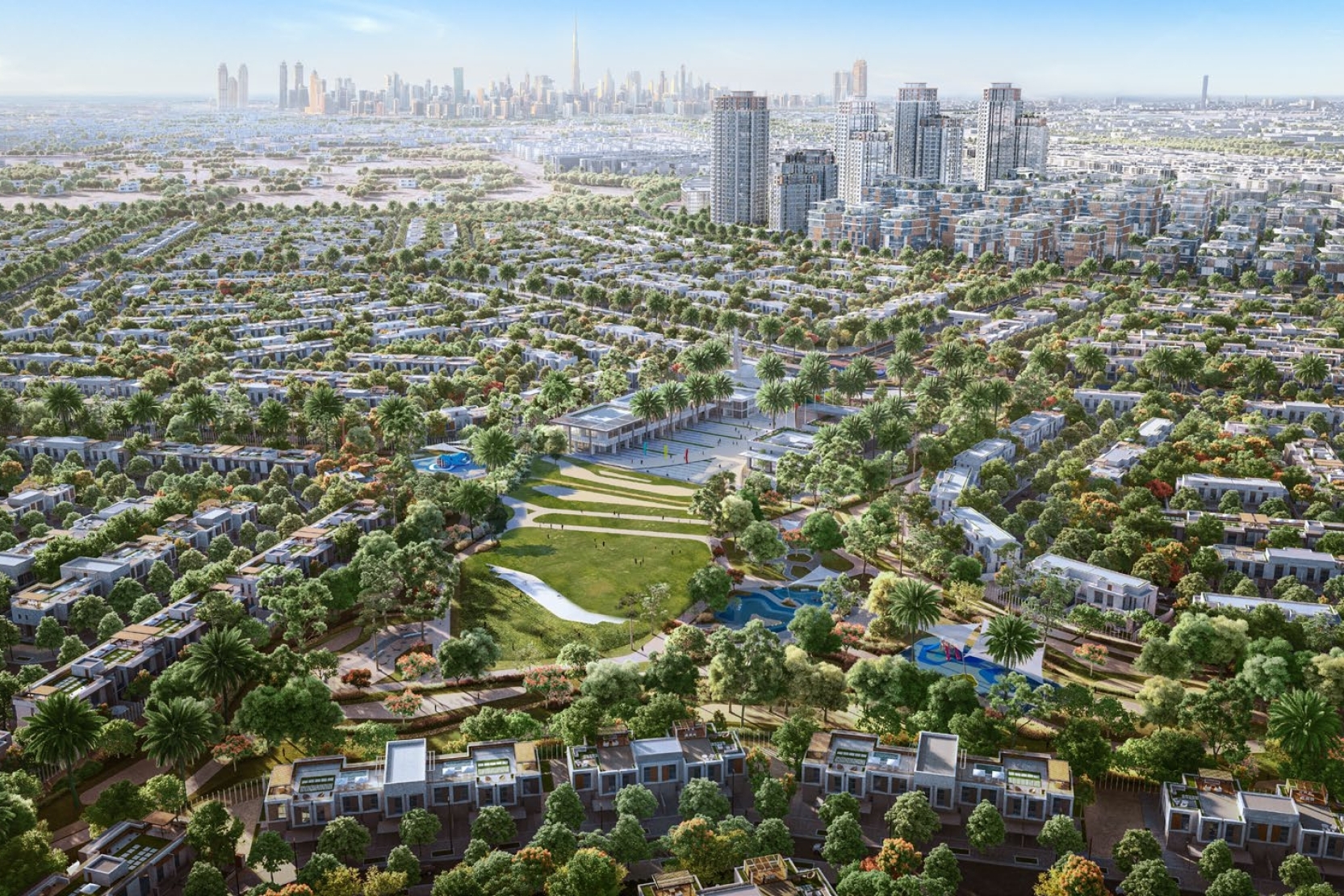
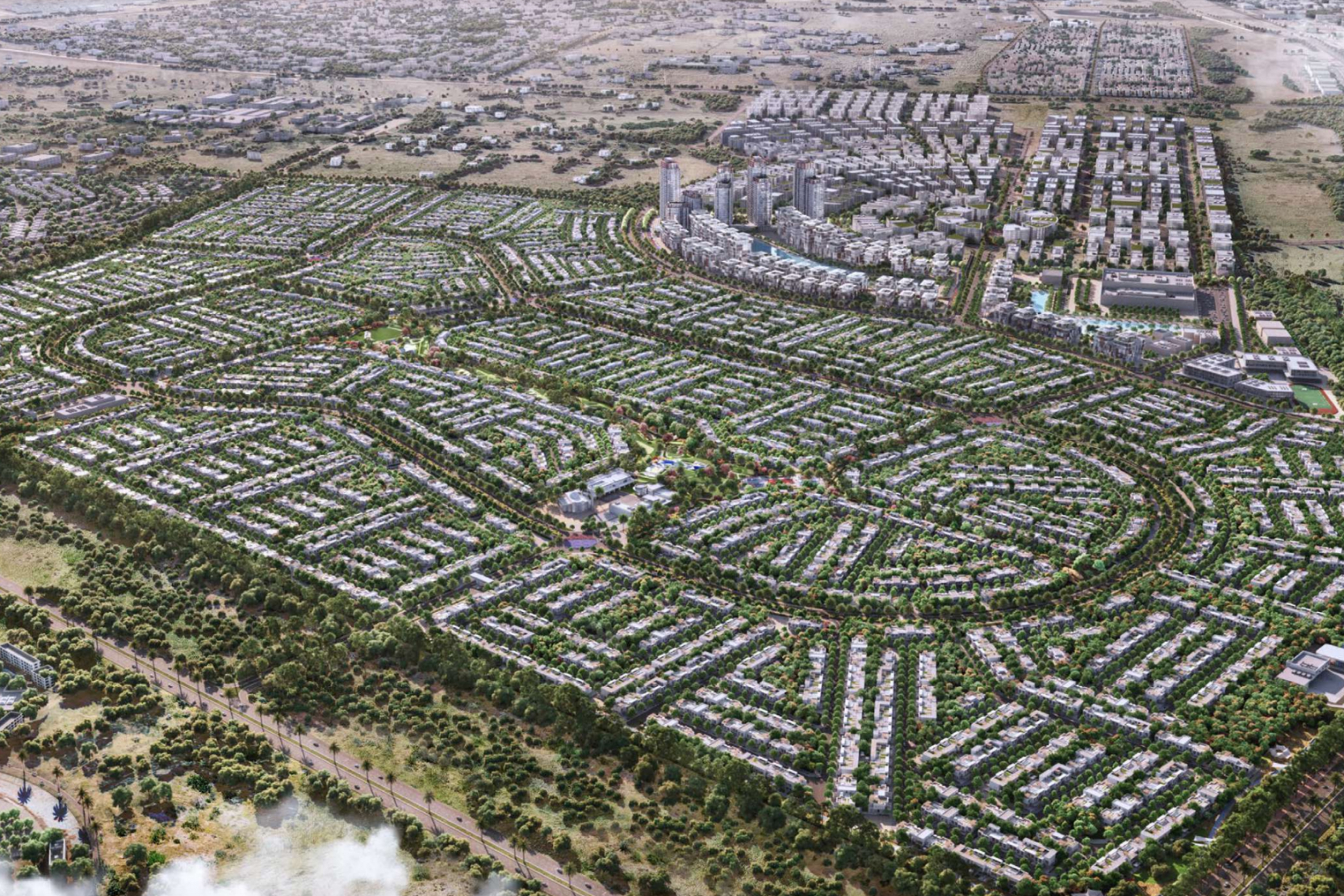
Green Wood, the 395-hectare Nakheel development under construction in Warsan 4 with Q1 2026 delivery, is explicitly structured around Transit-Oriented Development principles. The masterplan includes a designated TOD zone — comprising mixed-use buildings and Pond Park Apartments — described by Nakheel as positioned to benefit from a new metro station in the future. The apartment typologies in this zone are specifically low to mid-rise G+5, G+9 and G+12 structures — the density profile associated with transit-oriented development globally.
Nakheel — a government-backed developer — does not design transit-oriented zones around speculative future stations. This is infrastructure planning in reverse: the development is built to receive a metro connection that the developer has confidence will arrive. That confidence is well-founded given the confirmed Blue Line route through International City, which borders Green Wood directly.
For investors in Green Wood specifically, this means the development has been architecturally oriented to maximise the value capture of future metro connectivity. The TOD zone is not simply proximate to the route — it is designed around it.
The appreciation timeline: where the window sits now
Infrastructure-led property appreciation in Dubai follows a consistent pattern. Markets move on confirmation and construction progress, not solely on opening day. The sharpest entry points historically sit in the period between confirmed route announcement and visible construction — when the investment case is clear but not yet reflected in asking prices.
For Warsan 4, the timeline positions investors as follows.
| Phase | Status | Typical market behaviour |
|---|---|---|
| Route confirmed | Completed 2023 | Early investor interest begins; prices start moving in anticipation |
| Groundbreaking | Completed June 2025 | Broader market awareness increases; analyst coverage intensifies |
| Active construction visible | Underway now — 12% complete | Momentum buyers enter; volume picks up; prices accelerate |
| 30% completion milestone | Target: end of 2026 | Media attention peaks; broader retail investor entry; prices approach new baseline |
| Opening day | 9 September 2029 | Full repricing complete; yield premium stabilises; entry premium established |
Warsan 4 is currently in the active construction visible phase. The route is confirmed. Excavation is underway at International City 1, 2 and 3. The 22.32% year-on-year price appreciation recorded in Al Warsan 4 over the last 12 months reflects — at least in part — market pricing of the Blue Line's arrival. That pricing has begun. It has not completed.
The remaining appreciation window closes progressively as construction advances and as the opening date draws closer. Historically in Dubai, the full metro premium is substantially priced in before opening day. Investors who enter after a line opens are buying an established market, not positioning ahead of one.
What changes for tenants when the Blue Line opens
The tenant impact of Blue Line connectivity is as important as the capital appreciation story — because sustained rental demand is what supports long-term yield in affordable communities.
Currently, Warsan 4's tenant base is weighted toward those who work in the eastern Dubai industrial and logistics corridor and for whom road-based commuting is the primary mode. Metro connectivity shifts that profile materially. A resident in Warsan 4 with a direct metro connection to Creek Interchange and onward to the Green Line, or to Centrepoint and onward to the Red Line, has practical access to Downtown Dubai, Business Bay, DIFC and Dubai International Airport. Commute times that currently require a car drop to between 25 and 40 minutes on public transport.
That change in commute profile opens Warsan 4 to a significantly broader tenant pool: professionals working in central business districts who currently cannot consider the community because the commute is unworkable without a car. This demographic shift — which has been observed in every Dubai community that gained metro connectivity — supports higher rents, lower vacancy rates and a more stable long-term income profile for investors.
The reduction in traffic congestion — projected at 20% along Blue Line corridors — also has a secondary effect on quality of life and desirability for the community that is separate from the commuting change. Warsan 4's proximity to E311 currently serves it well. Post-Blue Line, the combination of highway access and metro connectivity places it in a category of infrastructure advantage that few affordable Dubai communities currently have.
What investors should consider carefully
Three years is a long holding period. The Blue Line opens in September 2029. Investors entering now are committing to a minimum three-year horizon to capture the full opening-day effect. Those who need capital liquidity within one or two years carry timing risk if market conditions soften before the line opens.
Not all proximity is equal. The 25% appreciation projection applies to properties near stations. Warsan 4's western edge is closer to International City's station locations than its eastern edge. Walking distance from specific buildings to the confirmed station entrances will determine which properties capture the walkability premium and which capture only the area-level effect. This due diligence matters before purchase.
The appreciation has already started. Warsan 4 recorded 22.32% year-on-year price per sqft growth in the last 12 months. Some portion of the Blue Line premium is already reflected in current asking prices. The remaining upside is real but investors should not assume all 25% of projected appreciation lies ahead from today's entry point.
Infrastructure timelines can shift. The September 2029 opening date is the current RTA programme. Large metro projects carry construction complexity. The Blue Line has reached 12% completion and is tracking its milestones — but investors should hold the timeline as a probability, not a certainty, and build their investment thesis around the long-term structural change rather than a specific opening date.
Supply is increasing simultaneously. Multiple developments are delivering in Warsan 4 and International City concurrently with Blue Line construction. Short-term rental pressure from elevated supply is possible. The long-term demand case is strong; the 12 to 24-month rental market may be more competitive than the medium-term outlook suggests.
The longer view
Every metro line Dubai has built has repriced the communities it serves. The Red Line transformed Marina and JLT. The Green Line stabilised and strengthened Deira and Bur Dubai. The Blue Line, connecting three stations directly into the International City and Warsan corridor, is the same force operating on a community that has historically been held back by a single structural limitation: the absence of rail connectivity.
That limitation expires on 9 September 2029.
What remains is a three-year period in which Warsan 4 is still priced as an area without metro access, in a city where metro proximity consistently commands a measurable and durable premium. The construction is underway. The government investment is confirmed. The developer ecosystem — anchored by Nakheel's Green Wood and its explicitly transit-oriented masterplan — is already aligned to the infrastructure.
The Blue Line does not guarantee any individual investment outcome. What it does is remove the single most frequently cited reason not to invest in Warsan 4. That is a material change, and markets generally price material changes well before they are delivered.
The information in this article is provided for general guidance and market awareness. The RTA's 25% property value projection is sourced from official Dubai Media Office statements by the RTA Director General. Historical appreciation data attributed to CBRE as cited in industry research. Property price and yield data is indicative and subject to change — verify against current DLD transaction records before any investment decision. Blue Line construction timelines are current as of December 2025 and subject to change. All information current as of March 2026.
