
Most off-plan buyers plan for the final instalment and stop there. That is the mistake. Handover brings its own set of payments — registration, utilities, district cooling, service charges — and many of them are not explained clearly at the sales stage.
On a AED 1.5 million unit, the completion-stage costs can easily run into tens of thousands of dirhams. Buyers who budget for them early avoid rushed decisions at the worst possible moment.
This checklist sets out every cost you should expect, what each one is, which are refundable, and which you are entitled to question. Every figure has been checked against at least two sources.

- Your final instalment is not your final cost — budget separately for registration, utilities and service charges
- If you paid the 4% DLD fee at Oqood registration, you do not pay it again at handover — only a small title deed issuance fee
- DEWA requires a refundable AED 2,000 deposit for apartments (AED 4,000 for villas) plus around AED 120 in activation fees
- District-cooled buildings add a separate chiller account with Empower or Emicool, depending on your area — each with its own refundable deposit and fees
- Service charges normally start from possession — but a 2025 Rental Disputes Center ruling makes buyers liable from completion if the delay is their own fault
- Any fee not set out in your Sales and Purchase Agreement can be questioned in writing
- The developer remains liable for defective installations for one year from handover, and for structural defects for ten years from the completion certificate
Before anything else: read your SPA
Your Sales and Purchase Agreement is the reference point for every handover payment. It should state what is payable, to whom, and when. If a developer introduces a charge that does not appear in the contract, you are entitled to ask for a written justification and a breakdown before paying it.
This matters more than it used to. Developers are under margin pressure, and some recover costs through administrative add-ons at handover. Dubai's regulatory framework gives buyers firm ground to push back. A charge that is in the contract is an obligation. A charge that is not is a negotiation.
The checklist: every cost at handover
| Cost | Typical amount | Refundable? |
|---|---|---|
| Final instalment | Per your payment plan | No |
| DLD 4% fee | Not due again if paid at Oqood | No |
| Title deed issuance | Small fixed fee — commonly quoted around AED 250 | No |
| DEWA deposit | AED 2,000 apt / AED 4,000 villa | Yes |
| DEWA activation fees | ~AED 120 (small meter) | No |
| District cooling deposit (Empower / Emicool) | Empower: AED 2,000 apt / AED 3,000 villa Emicool: 8 months of capacity charge | Yes |
| District cooling connection (Empower / Emicool) | Empower: AED 2,000 + AED 1,000 admin Emicool: set by provider — confirm before handover | No |
| Service charges in advance | RERA-approved rate × unit size | No |
| Reserve fund contribution | Where required by the SPA | No |
* Utility amounts reflect published provider fees as of 2026 and may change. District cooling applies only to buildings connected to a provider. Empower and Emicool set their own charges, so confirm the amounts with the provider serving your building.
1. The final instalment
This is the balance due under your payment plan — for example, 40% on a 60/40 plan. It is usually the largest single payment at handover, and the one most buyers already expect. If you are funding it with a mortgage, the bank will need the unit to be complete and valued first, so start that process well before your handover date.
2. DLD registration and the title deed
Off-plan purchases are registered with the Dubai Land Department through the Oqood system, and the 4% DLD fee is normally paid at that stage. At handover, the Oqood is converted into a full title deed. If the 4% was already paid, it is not charged again — only a small title deed issuance fee applies.
If your developer offered a DLD waiver, or deferred the fee, check your SPA for when and how it is settled. The National's guidance lists DLD registration fees as a handover cost only where they were not already paid.
You can take the keys and rent the unit out, but you will not receive the title deed at handover. Your Oqood stays in place, and the title deed is issued only once your final post-handover instalment is paid. This affects your ability to sell or refinance during that period.
3. DEWA connection
Electricity and water are connected through DEWA's move-in service, using your title deed or Oqood. The costs are standard across residential properties:
That puts the upfront cost for a standard apartment at around AED 2,120. Larger meters carry a AED 300 connection fee instead of AED 100. The deposit is the same whatever the unit size — a studio pays the same AED 2,000 as a three-bedroom apartment — and it is returned when you close the account, net of your final bill.
4. District cooling (Empower / Emicool)
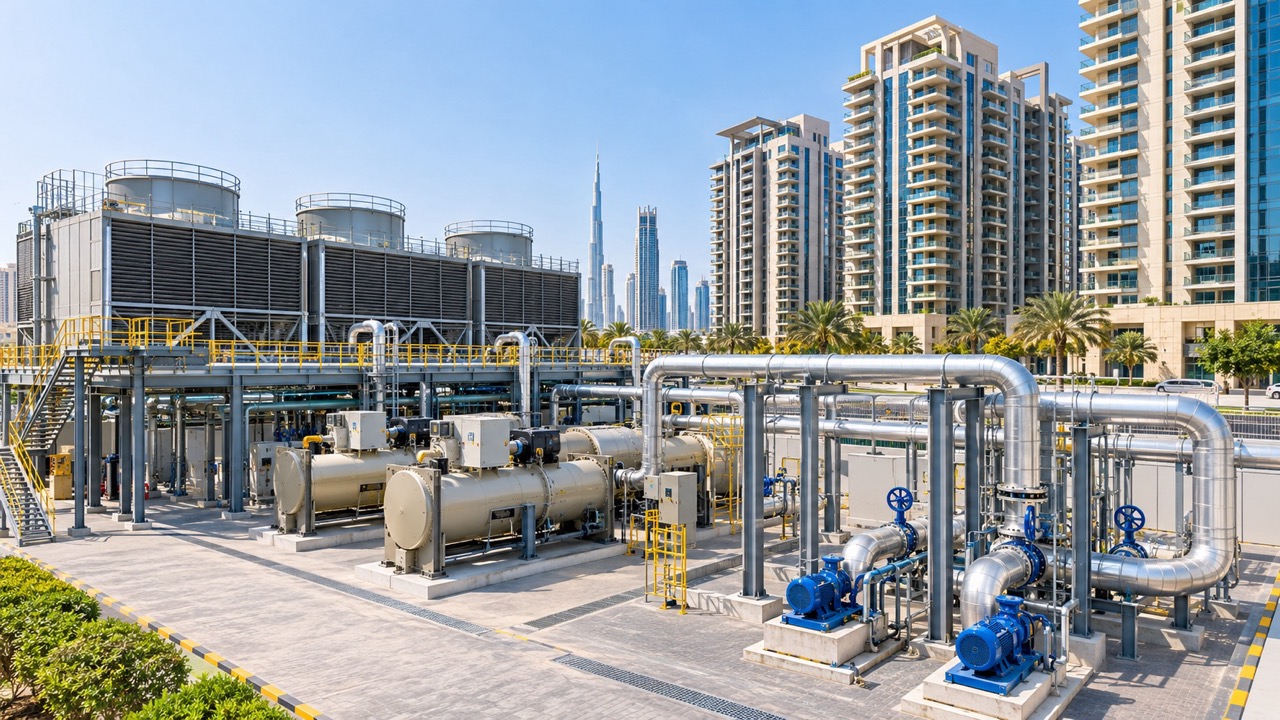
Many Dubai buildings are cooled by a district cooling provider rather than individual AC units. If yours is, you open a second utility account, separate from DEWA, with its own deposit and fees. The two main providers are Empower and Emicool, and which one serves you depends on your community.
Empower: the refundable security deposit is AED 2,000 for an apartment and AED 3,000 for a villa, alongside a one-time connection charge of AED 2,000 and an administration fee of AED 1,000.
Emicool: there is no single standard deposit. Emicool sets it at an amount equal to eight months of the unit's contracted capacity charge, so it varies by unit and project. Ask Emicool or your developer for the exact figure before handover.
Not every building uses district cooling, and some are marketed as "chiller-free", where cooling is covered within service charges. Confirm which applies to your unit before handover — it changes both your upfront costs and your monthly running costs.
5. Service charges in advance
At handover, the owners' association typically invoices service charges in advance, from your handover date to the end of the service charge period. The rate is set per square foot, approved by RERA, and collected through the Mollak system — so you can check the approved budget for your building before you pay.
This is the cost buyers most often underestimate, because off-plan service charges are estimates at the time of sale. The actual approved rate at handover can differ. Ask for the current RERA-approved rate before your handover date, not after.
6. Reserve fund contribution
Some developers require an initial contribution to a reserve fund — sometimes called a sinking fund — which pays for long-term building maintenance and major replacements. Whether this applies, and how much it is, should be set out in your SPA.
When do service charges actually start?
This is one of the most contested questions in Dubai's off-plan market, and much of the advice online gets it only half right.
The general principle is that the obligation to pay service charges begins when you obtain possession of the property, not before. If a developer invoices you for a period before you were allowed access to the unit, you are within your rights to challenge it, and can ask RERA to intervene.
There is an important exception. In October 2025, the Dubai Rental Disputes Center established that where handover is delayed because of the buyer — for example, by missing payments — a buyer listed in the interim property register is liable for service charges from the date the project is completed, or from the date they defaulted, whichever comes first.
"This decision closes a legal gap and ensures fairness for compliant owners and developers."
Judge Abdulqader Mousa Mohammed, President, Dubai Rental Disputes Center — via Gulf News, October 2025
In practice: if you are ready and the developer delays, service charges should run from your handover date. If the delay is on your side, expect to pay from completion.
Snagging and your defect rights
Snagging means inspecting the finished unit against your contract, floor plan and specification, and listing every defect before you sign the handover certificate. Defects recorded before signing are the developer's to fix. Defects found afterwards are harder to pursue.
Your statutory protection comes from Article 40 of Dubai Law No. 6 of 2019 on jointly owned property, which sets two liability periods:
| What is covered | Period | Clock starts |
|---|---|---|
| Structural parts | 10 years | Project completion certificate |
| Installations — mechanical, electrical, sanitary, sewerage | 1 year | Handover of the unit to you |
Most snagging issues — a faulty socket, a leaking trap, a failing AC unit — fall within the one-year period, not the ten-year one. Note also that if you refuse to take possession, the one-year period starts from the completion certificate instead, so delaying handover does not extend your protection.
A worked example
The figures below are illustrative. Your actual amounts depend on your SPA, your building's approved service charge rate, and whether it is district-cooled.
AED 1,000,000 unit, 800 sqft, district-cooled by Empower
Empower is used here because its fees are published as fixed amounts. In an Emicool building, the deposit line would differ.
| Final instalment (40%) | AED 400,000 |
| DLD 4% (already paid at Oqood) | AED 0 |
| Title deed issuance (approx.) | AED 250 |
| DEWA deposit + fees | AED 2,120 |
| Empower deposit + connection + admin | AED 5,000 |
| Service charges, 12 months at an illustrative AED 15/sqft | AED 12,000 |
| Due at handover on top of the instalment | AED 19,370 |
Of that AED 19,370, about AED 4,000 is refundable deposits. The rest is a real cost. And it excludes any reserve fund contribution, developer admin fees set out in your SPA, furnishing, and the cost of a snagging inspection.
Your pre-handover checklist
Re-read your SPA
List every payment it requires at handover. Anything else the developer asks for, request in writing with a justification.
Confirm how the DLD fee was handled
Check whether the 4% was paid at Oqood, waived, or deferred — and if deferred, when it falls due.
Get the approved service charge rate
Ask for the RERA-approved rate per square foot and verify it on Mollak. Do not rely on the estimate from the sales stage.
Check the cooling arrangement
Find out whether your building is district-cooled, whether it is served by Empower or Emicool, and what that provider's deposit and fees are.
Line up your final payment
If you are using a mortgage for the final instalment, start the application early. The bank will need the completed unit valued before it releases funds.
Snag before you sign
Inspect the unit — or have it inspected — and record every defect before signing the handover certificate.
Ask about building move-in rules
Some buildings require a move-in permit or a refundable deposit to protect common areas. Check with building management in advance.
The bottom line
Handover is not a single payment. It is the final instalment plus a cluster of smaller costs that, together, can add tens of thousands of dirhams to your purchase. None of them should be a surprise.
The buyers who handle handover well do three things. They read their SPA before the handover notice arrives. They confirm the actual service charge and cooling arrangements rather than relying on sales-stage estimates. And they know their rights — on service charge timing, on fees outside the contract, and on defects — before they sign anything.
The information in this article is provided for general guidance only and does not constitute legal or financial advice. Fees, deposits and regulations change and vary by developer, building and provider — confirm all amounts with your developer, DEWA, your district cooling provider and the Dubai Land Department before handover. The worked example is illustrative and uses assumed figures. Sources include The National, Gulf News, Khaleej Times, Legal 500, Dubai Law No. 6 of 2019 (Article 40), published DEWA and Empower fee schedules, and Emicool's published terms. Information current as of November 2026.
